Sunday, 1 July 2012

the london chinatown dolls


We’re delighted that The London Chinatown Dolls will be performing for us!  Led by American-born Miss Amelia Kallman and her partner, Bristol’s own Norman Gosney, the Dolls make magic on a nightly basis and on November 17th, they’ll be producing that magic in Bristol.

Miss Amelia is a talented performer, writer, and director and in 2004, she and Norman Gosney (an acclaimed nightspot designer and producer of nouveau cabaret burlesque events) opened a notorious and now legendary speakeasy, dazzling an exclusive, bohemian and celebrity cliental with such shows as ‘Guilty Pleasures’ and ‘The Blushing Diamond Revue.’ In 2007 they moved to Shanghai, China where they opened the first burlesque nightclub in Asia, the award winning ‘Gosney & Kallman’s CHINATOWN.’ They led their talented ensemble troupe, performing shows in Hong Kong, Borneo and Malaysia (the first show of it’s kind in a Muslim country).  Miss Amelia’s memoir on their Asian adventure, titled ‘Diary of a Shanghai Showgirl’ is due for publication in Spring 2013.

What can you expect on the night?  Well Miss Amelia is an acclaimed showgirl comedian who’ll be leading The London Chinatown Dolls, the chorus line regularly featured in their new groundbreaking London show, “When Worlds Collide”.  There’ll be four big production numbers across the evening, including a performance of a brand new 1920s number, specifically made for this event!  All the costumes are specially designed and made by Miss Amelia herself and joining her on stage, on the night, will be Miss Miranda, Kitten von Strumpet, Hotcake Kitty and Emerald Fontaine.  

We can’t wait to see them perform and we’re thrilled that they’re bringing their skills and love of nightlife entertainment to Bristol. Till then, you can find out more on their website, follow Miss Amelia on Twitter and check out a review or two, to whet your appetite:


Twitter: @AmeliaKallman
chinatown dolls tumblr page: here
chinatown dolls facebook page: here

art

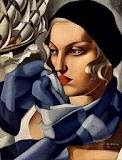
Tamara de Lempicka  was born in Warsaw to a wealthy and prominent family . . She attended boarding school in Lausanne, Switzerland, and spent the winter of 1911 with her grandmother in Italy and on the French Riviera, where she was treated to her first taste of the Great Masters of Italian painting.
She had to flee Russia during the revolution and finally settled in Paris. During the Roaring 20s Paris, Tamara de Lempicka was part of the bohemian life: she knew Pablo Picasso, Jean Cocteau, and André Gide. Famous for her libido, she was bisexual, and her affairs with both men and women were carried out in ways that were scandalous at the time.
Her distinctive and bold artistic style developed quickly (influenced by "soft cubism" and by "synthetic cubism") and epitomized the cool yet sensual side of the Art Deco movement


George Barbier was one of the great French illustrators of the early 20th century. Born in Nantes, France on October 10, 1882, Barbier was 29 years old when he mounted his first exhibition in 1911 and was subsequently swept to the forefront of his profession with commissions to design theatre and ballet costumes, to illustrate books, and to produce haute couture fashion illustrations.. In the mid 1920s he worked with Erté to design sets and costumes for the Folies Bergère.


Erté Romain de Tirtoff was a Russian-born French artist and designer known by the pseudonym Erté, the French pronunciation of his initials, R.T. He was a diversely talented 20th-century artist and designer who flourished in an array of fields, including fashion, jewellery, graphic arts, costume and set design for film, theatre, and opera, and interior decor.
Erte designed over 200 covers for Harper's Bazaar but he is perhaps most famous for his elegant fashion designs which capture the art deco period in which he worked.


Pierre Brissaud was a French Art Deco illustrator, painter, and engraver. He was born in Paris and trained at the École des Beaux-Arts and Atelier Fernand  Cormon in Montmartre, Paris.
Brissaud is known for his pochoir (stencil) prints for the fashion magazine Gazette du Bon Ton published by Lucien Vogel, Paris. Many of his illustrations are realistic leisure scenes of the well-to-do.


dance

The Charleston is a dance named for the harbor city of Charleston, South Carolina. Developed by Kathryn Wilson, the Charleston became a popular dance craze in the wider international community during the 1920s. Despite its origins, the Charleston is most frequently associated with white flappers and the speakeasy. Here, these young women would dance alone or together as a way of mocking the "drys," or citizens who supported the Prohibition amendment, as the Charleston was then considered quite immoral and provocative.


Black Bottom refers to a dance which became popular in the 1920s, during the period known as the Flapper era. The dance originated in New Orleans in the 1900s (decade). The theatrical show Dinah brought the Black Bottom dance to New York in 1924, and the George White's Scandals featured it at the Apollo Theater in Harlem 1926 through to 1927. The dance became a sensation and ended up overtaking the popularity of the Charleston, eventually becoming the number one social dance.


The Shim Sham Shimmy, Shim Sham or just Sham originally is a particular tap dance routine. The Shim Shim is 10 phrases of choreography (each phrase lasting four 8-counts).
In the late 1920s and the 1930s, at the end of many performances, all of the musicians, singers, and dancers would get together on stage and do one last routine: the Shim Sham Shimmy. Tap dancers would perform technical variations, while singers and musicians would shuffle along as they were able.


The Ziegfeld Follies were a series of elaborate theatrical productions on Broadway in New York City from 1907 through 1931. The Follies were lavish revues, something between later Broadway shows and a more elaborate high class Vaudeville variety show. Inspired by the Folies Bergeres of Paris, the Ziegfld Follies were conceived by Florenz Ziegfeld.


cosmetics

Cosmetics in the 1920s were characterised by their use to create a specific look: lips painted in the shape of a Cupid's bow, kohl-rimmed eyes, and bright cheeks brushed with bright red blush
The heavily made-up look of the 1920s was a reaction to the demure, feminine Gibson girl of the pre-war period


In the 1920s, an international beauty culture was forged, and society increasingly focused on novelty and change. Fashion trends influenced theatre films, literature, and art. 


Women also found a new need to wear more make-up. A skewed postwar gender ratio created a new emphasis on sexual beauty. Additionally, as women began to enter the professional world, publications such as the French Beauty Industry encouraged women to wear makeup so as to look their best while competing with men for employment.


the bob

A "bob cut" is a short haircut for women in which the hair is typically cut straight around the head at about jaw-level, often with a fringe at the front. Traditionally women in the west had worn their hair long and short hair was not considered respectable. An exception was Lady Diana Cooper an aristocratic socialite who had always worn her hair short.


Lady Diana Cooper, Viscountess Norwich


After working as a nurse during the war and working as editor of the magazine Femina, she wrote a column in the Beaverbrook newspapers before turning to the stage and latterly silent films. 

The First World War was a major factor as women who were engaged in war work found long hair an inconvenience. Renowned dancer and fashion trendsetter Irene Castle introduced the bob to an American audience in 1915 calling it “the castle bob”.


The hairstyle was further popularised by film stars Colleen Moore and Louise Brooks in the early 1920s, it was then seen as a somewhat shocking statement of independence in young women.


Hairdressers, whose training was mainly in arranging and curling long hair, were slow to realise that short styles for women had arrived to stay, and so barbers in many cities found lines of women outside their shops, waiting to be shorn of hair that had taken many years to grow.